29 October, 2013

A Plug for a Shrike

Even though I'm sat 120 miles away, I couldn't help but punch the air at the familiar report of a Great Grey Shrike at Thursley Common last week. Presumably the same individual has made the Common its favoured wintering grounds for a number of years now, and despite the bird's tendency to become lost amongst the miles of heathland for hours on end, I managed a number of memorable encounters with the Shrike last winter.


That first distant glimpse of a pale blob perched atop a tree a mile away is enough to brighten up even the bleakest of winter mornings...


Once tracked down and given a sensible approach, the Shrike will often show beautifully. Take your eye off it for even a moment though, and your next view of it will most likely be a flash of wing bars on the other side of the heath. It doesn't hang around.


With a supporting cast of Woodlark, Dartford Warbler, Raven and Hen Harrier, Thursley offers some of Surrey's juiciest winter birding opportunities. Well worth the trip down the A3 if you ever find yourself with nothing to do on a Sunday morning.

02 October, 2013

Back in Business

Apologies for the radio silence recently- what with me being an official Uni Fresher and all, I'm probably going to become more and more of an unpredictable maverick as the year progresses. Be warned.

University has been a great laugh so far, with Fresher's Week pretty much summed up in three words; drinks and money (taking in lots of the former whilst burning through most of the latter). The first night saw me lose my debit card whilst out a nightclub with the new housemates, resulting in the rest of the week being spent drinking the cheapest, shittest alcohol imaginable- Ikea's own brand cider comes to mind as being one of the less great tasting beverages I drank during the week. Imagine rotten eggs with a hint of apple... yeah. 

Anyway, we're now two weeks into lectures, and the Conservation Ecology course I'm taking is really starting to become interesting. The vast majority of sessions are spent in the field, which is ideal since I've never been a fan of note-taking lectures. One particular module is focused completely on practical volunteer work at various nature reserves in the local area, whilst another focuses on actually getting out in the field and become familiar with the ID features of some of the lesser known British taxon. There's a bit of geography and some annoying chemistry mixed in, but overall the course looks brilliant, with plenty of like-minded students who share similar interests, and some friendly lecturers to motivate us. 

Today's session mean't going to a nearby woodland to study autumn fungi. What a chore.

Notable finds included Drab Bonnet (Boletus edulis), Pear-shaped Puffball (Lycoperdon pyriforme), Penny Bun (Mycena aetites) and Turkey-tail (Coriolus versicolor)- as badly sketched above. Sadly no magic mushrooms about.

Now Fresher's Week is over, I've been itching to get out and about to explore the Malvern Hills and surrounding Worcestershire countryside. Grimley Camp Lane Pits, a few miles up the road, looks like a decent contender for my new local patch; Wood Sandpiper, Black Tern, Little Gull and an assortment of waders have all been seen there in the past few weeks. The University runs a pretty handy bike loan scheme, so I should be able to check it out in the next day or two.

Watch this space.

14 September, 2013

Worcester Bound

Packing sorted, various forms filled in and clown fancy dress outfit arranged- I'm pretty much ready to head off to uni in the morning. It's an exciting time, but I'm not going to pretend that I won't miss the freedoms of a gap year. It really has been great fun- hardcore birding on Scilly back in October; hiking and cycling across Shetland in May; helping manage the backstage collections at the Natural History Museum; a month's conservation work at the bird observatory on Fair Isle... not to mention a few weeks of R&R in California.

So what will this whole University thing mean then? Well, first off it means I won't be in Surrey anymore; I'll be up in the Midlands- Worcester to be precise. I'll come back ever now and then, but the local patches of Stokes Field and Bushy Park will take have to take back seats for a while. It also means I'll be studying an Ecology course, which in itself means I am probably going to have to do some work at some point during the the next three years. Despite a new commitment, I'll still try and keep the blog going whilst I'm away (you might have to bare with me for the first few weeks), and I still aim to get out and about as much as I always have, just with a shiny new park to play in.

Cheers all for reading. Who knows, maybe I'll actually come away from it all with a degree.

I'll leave you with a selection from recent warm, early autumn afternoons spent wandering the North & South Downs. Now those are some views I'm going to miss. Damn.


10 September, 2013

How (Not) to Prepare for University

With Fresher's week at Worcester Uni just a short and sweet five days away, I spent the vast majority of yesterday attempting to pull my act together in preparation for the real thing. High on the agenda of stuff that needed doing was to sort out a shiny new banking 'student account' to harbour thousands of quid worth of loans that our war-supporting, badger killing government has so kindly lent to me. Of course, I could just do all my banking in my existing account, but with a new Lloyd's student account I get the added benefit of £500 overdraft, which means I've now got the opportunity to borrow even more money. Blimey, I could get rich out of this.

With banking out the way, thoughts turned to a more important part of the University preparation process; purchasing a wristband. I can't admit that they are often high on my list of things to buy, but when that wristband entitles you to free entry into a week's worth of clubbing venues with thousands of other drunk & desperate freshers, action has to be taken. It won't be clean, I'll admit. Having left almost everyone and everything I know back at home, and with most other students in the same desperate boat, alcohol will probably never play a more important role in our lives. I will most likely end up getting completely hammered beyond my wildest dreams, utterly wrecked, sloshed, trollied, inebriated... you get the drift, but it will be a laugh, and I can't wait. Pretty much all that's left to do now is to stock up on pots, pans and other fancy homeware shite- I did spend quite a while yesterday afternoon prancing around WHSmiths like a little child, picking out lots of colourful gel pens and dinosaur shaped rubbers, but they probably won't be much help to me when I attempt to cook for myself.

Of course, it wouldn't be a truly successful day without seeing some birds, and whilst I was faffing around in town, a very thoughtful Wood Sandpiper decided to turn up at Berrylands- a small under-watched sewage works five minutes away. The little beauty showed in all its distant glory, feeding on a patch of mud with a Green Sandpiper and a load of Teal, as a few of us watched from the station platform. I can't even begin to imagine the number of times I've passed that reservoir whilst on the train to Waterloo, completely oblivious to any of the gems that might be lurking there. Hats off to the sharp-eyed commuter who scored the Sandpiper in the first place.

Whilst I'd like to say this is a painting I did when I was five, it's not. It's a photo of the actual bird... I know. I'm afraid this isn't one of those 'wildlife photography blogs' anymore. In fact it never was. 

05 September, 2013

Crambinae tribute

Caloptria falsella

Agriphila latistria

Agriphila tristella

Agriphila straminella

Chances are that no matter where you are in Britain you would have flushed one of the above 'grass moths' at some point during the summer. These members of the large sub-family Crambinae, relatively easily distinguished by their elongated posture and distinctive snout, reach a peak in early August and usually fly until earlish September. The above four species were all attracted to the moth trap after dark, and given that their abundance at this time of year makes them hard to overlook, I thought it only right to post a tribute to this entertaining group. Some of the commoner species in the family are happy to utilise any kind of grassy habitat, even lawns; walking aimlessly around over your garden turf will usually prove successful. Flush 'em whilst you can though... give it another week and most of them be gone, along with the summer weather by the looks of things.

01 September, 2013

Quick one from Dorset

Just thought I'd do a quick one with a few odds and ends from a glorious couple of days spent wandering the sandy beaches and chalky clifftops of the Purbeck area of Dorset. I'd initially planned to use the time as an excuse to do as much of nothing as possible, but the huge potential of the area for searching for wild beasts was too good an opportunity to miss, and I inevitably ended up wondered off the beaten track more times than I stayed on it.

Studland has always been high on my list of places to visit. Owned by the National Trust, the beach itself is extremely popular with tourists at this time of year, but walk a few metres back from the sea and you find yourself completely at one with rich coastal heathland...


Ruddy DartersBlack Darters and Migrant Hawkers were patrolling the marshy areas for smaller insects, no doubt taking advantage of swarms of late-season hoverflies that were nectaring on the flowering heather. Frustratingly fleeting glimpses of a few elusive Sand Lizards were had, but the highlight had to be watching a Clouded Yellow come in off the sea... full frontal butterfly migration before the eyes. Mind blown.


Note how the final segments widen to give the abdomen of this Ruddy Darter a distinctively clubbed appearance...


Black Darter; nice to catch up with this late-season specialist after missing it at Esher Common the other week...


Blue-tailed Damselfly, although it took a bit of ummin' and arrrin' to separate it from the very similar Scarce Blue-tailed Damselfly which also inhabits heathland, confusingly...


Eupeodes luniger, a migrant hoverfly...


Sphaerophoria scripta...


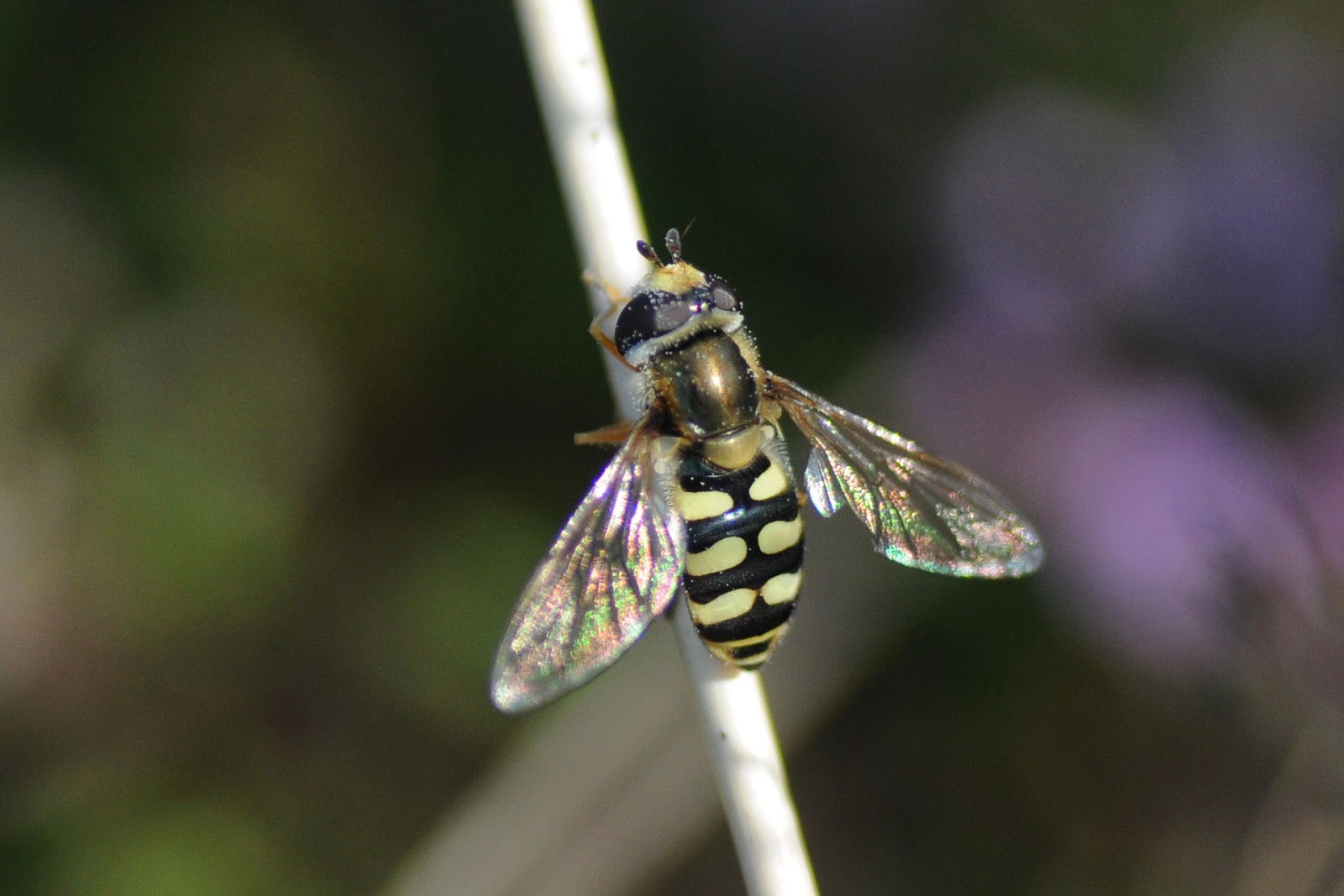
Troublesome hoverfly of some kind...


Mottled Grasshopper, belated identified from photos only after I'd spent hours convincing myself that it was the much rarer Heath Grasshopper. Doh.


In other news, I can't believe it's September already. How time flies when your having fun, eh? Two weeks from now and I'll no doubt be doubled over a toilet somewhere in Worcester, flushing down the alcoholic memories from the first night of being a fresher. Of course, this also means that I've only got two weeks left in the magical land of Surrey- minus the Tories, the private roads and the families who feel the need for five separate cars in their drive, I'm going to miss this place.

Now to start eyeing up a sparkly new local patch along the Welsh border. Any suggestions?

26 August, 2013

500 up

A few posts back I might have slipped in the fact that I was getting quite close to the wildly unimpressive milestone that is the 500th species of moth to be found in the garden. I'm not a massively organised person, and have never managed to commit to logging sightings in notebooks. I'm also pretty rubbish at keeping lists in general (explaining why I'm not a massively organised person), so the fact that I've managed to keep track of 500 different things would probably be more cause for celebration that the total itself.

With three consecutive nights of very mild, calm and cloudy conditions- perfect weather for moths- the 500th species quickly fell into place in the form of an unassuming Yarrow Pug. As with so many 'nationally scarce' moths that reach the trap, Yarrow Pug has increased its range in the Thames Basin in recent years, and is now locally common in small areas of London- t'was only going to be a matter of time before it dropped into the garden.


Moths are ace, there's no doubt about it. I've made a big deal out of it all, but 500 species is a very average haul for a garden. Most normal-sized gardens in the country could easily harbour upwards of this total- it's just a matter of  getting out at night to appreciate them, rather than wondering whether or not they're going to eat that knitted sweater that your mother-in-law made for you, when let's face it you don't really like it anyway. It's about two sizes too small, and you specifically asked for a chequered pattern, not diamonds.

If you haven't checked it out already, I've added the updated garden list on a separate page here- it's a pretty intense read.

24 August, 2013

Bashing around a Bog

Another sweltering day yesterday, so I had a bash around the established heathland of Esher Common in search of late season Odonata (the fancy word for dragonflies & damselflies). The summer heat has clearly taken its toll on the landscape, and the area of shallow boggy pools adjacent to Black Pond that usually provide prime habitat for dragonflies had completely dried up. As a result, the number of species on the wing was disappointingly low. Black Darters should be reaching a peak in activity in late-August, but instead were virtually non-existent. It will be interesting to see where where they lay their eggs this year given the lack of acidic pools; hopefully the Darters can utilize the reedbed borders of Black Pond.

Common Darters were also low in numbers, but a stunningly fresh Ruddy Darter patrolling the outskirts of the pond was great to see, and Migrant Hawkers were very numerous everywhere. The main attraction though was a colony of the localised Bog Bush Cricket that were out in healthy numbers in the heather. The species does well on the acid heaths of Surrey and Hampshire, but up until now I've never managed to catch up with them.

Pretty spectacular looking things...


23 August, 2013

A New County Moth


I had a cheeky feeling something good was due in the moth trap, but with torrential downpours making the last few night's trapping sessions particularly challenging, I certainly wasn't expecting this beauty. The moth looked interesting the moment it settled on the sheet suspended above the trap, and a quick search on UKmoths revealed it to be Ethmia quadrillella, a scarce species confined mainly to wetlands and fens in and around East Anglia. I flicked through the distribution maps in the Smaller Moths of Surrey atlas with excitement, and sure enough there was a blank space on the page where the species should have been. After further email correspondence with the big guns (county recorder Jim Porter and moth guru John Langmaid), it turns out I've got me the first record of this species for Surrey, which is swell and all, but still leaves one nagging question... Where has it come from? 

Is it part of a previously unknown breeding population in the southern counties that has only now made itself known in a suburb in Surrey? Is it a one-off wanderer from known strongholds further north, or could it be a genuine immigrant from mainland Europe- following in the footsteps of Surrey's 'first' Jersey Mocha which reached the garden during peak migration season in late August 2011. I'd like to think that the time of year, combined the fact that its arrival coincided with that of other well known migrants into the country (Clouded Yellow, Diamond-back Moth, Silver Y) would make a pretty strong case for it being a genuine international migrant, but it's all speculation, and that's one of the great mysteries of mothing. 

21 August, 2013

August Invertebrates

Today I found myself spending what was an absolute scorcher of an afternoon on Bookham Common, in the company of hundreds of thousands of invertebrates- it was basically heaven. One invert I particularly wanted to catch up with was Brown Hairstreak, a late emerging butterfly that has a stronghold around Blackthorn bushes in the more open areas of the Common. After hours of searching, I succeeded in finding one, but only managed an agonising glimpse as it flew away over a hedgerow at speed. The show was stolen though by a stonking Clouded Yellow; a migrant that has seen a fantastic influx this year into Britain. It came out of nowhere and slowly fluttered over the grassland, before continuing over the hedges and towards Bookham station. Surely this has to be one of the one of the best, if not the best year for this species in Surrey.

I'm absolutely useless when it comes to grasshopper identification, but with Orthopera providing the loudest soundtrack out in the grassland, it seemed rude not to have a go. Amongst the abundant Field and Meadow Grasshoppers was the rarer Rufous Grasshopper, a lover of rough calcareous downland in the south of the country, and one of the few grasshoppers that isn't an absolute bugger to identify...


One of the more beginner friendly grasshoppers, picked out of the crowd by the characteristic pale-tipped bulbous segment at the end of the antennae. All other grasshoppers (okay, apart from Mottled) have plain antennae.

Field Grasshopper...


Small Skipper are still out in good numbers, with double figures counted this afternoon. This one has certainly seen better days, though...


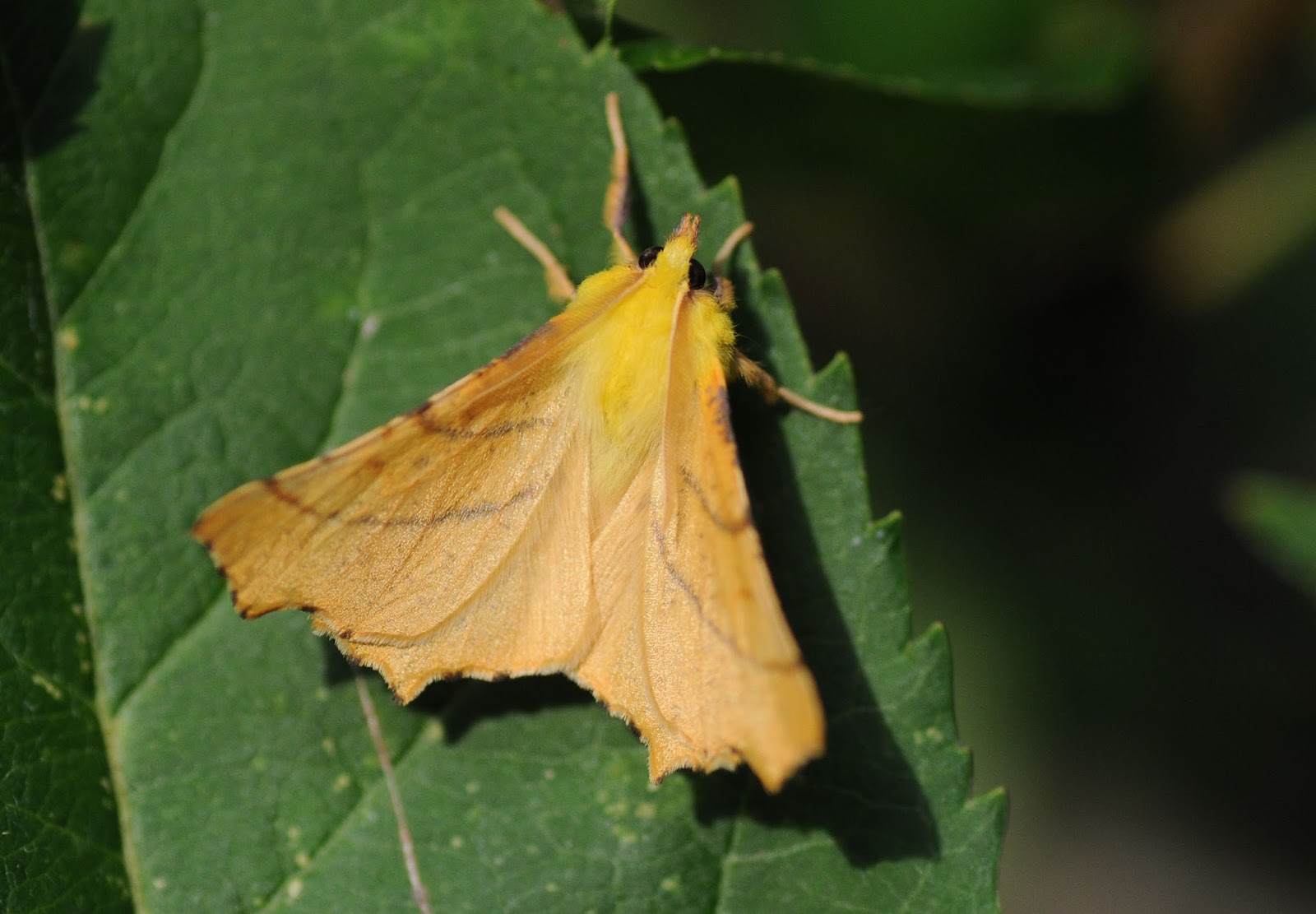
Back in the garden, the moth trap is still producing the goods. For whatever reason, mid to late-August always seems to be the most productive time of year down here, particularly in terms of 'rarities'. Hoary Footman and Tree-lichen Beauty appear to be two of the more common moths in the trap at the moment, whilst recent additions including Cabbage Moth, Orange Swift and Canary-shouldered Thorn bring the garden moth list to 486 species. With a new species every night for the next two weeks, the big 500 should be an easy total to reach before I head off to uni, and then we'll all have a massive piss-up to celebrate.


If you haven't already got it, here is a quick plug for the 'Photographic Guide to the Grasshoppers & Crickets of Britain & Ireland', part of the absolutely brilliant 'Wild Guide UK' series that also covers Shieldbugs and Squashbugs. Well worth the money.