27 November, 2010

Think Fluffy Bunnies

Think Fluffy Bunnies

God it's been cold recently hasn't it? Me and cold don't really mix that well, I find the cold too... how do I say this? ... chilly. The problem is me and warm do mix quite well, and I often find I'm late for one thing or another because I've spent over 2 hours in a steaming hot shower, no doubt draining the local reservoir and malnourishing a Dunlin or something.

I'm pretty sure you're flowing along my lines when I say a cold winters day spent with a good cup of tea in the lounge, in front of the T.V. *insert favoured program here* (preferably not Misfits or The Inbetweeners, I mean everyone talks about them but they are generally, and pardon my language, bad) with the central heating turned up, is pretty damn ideal.

In fact one of the only times when I do like the cold is when its snowing, and so with the recent forecasts pledging a frosting of the white stuff in every garden, I've been ready with camera in hand. Alas, there has been no snow, but with the sun out, I braved the cold and headed down to Bushy Park during one of those independent study periods at college. What do mean I should have be studying? Well... I'm... habitats, environment, stuff like that, you know the one... biology.

There were birds on the lake, but they were pretty boring. Just the odd Shoveler and Wigeon, and a Stonechat in the distance somewhere.

Here, have a Wigeon...


And a Mallard...


And a Tufted Duck with some late autumnal colours thrown in...


Here's a Stonechat...


And here's an un-focused Shoveler touching down...


Just in case you were wondering what a seagull looked like up close, wonder no more... this is field guide material right here...


I've just re-filled the bird feeders ready for the winter, so might try and dig out that brown sheet thing that acts like a hide and watch as the birds flee the garden and bugger off somewhere else. One thing that doesn't seem to want to bugger off at the moment is that damn Grey Squirrel.

I must say I quite liked the local Squirrels, and their daily antics during the summer. They weren't doing any visible harm and I'd happily wave at one as it passed gracefully through the trees. However, since putting feed out again, I've realised just how bloody annoying they are- casually hanging from a branch whilst stealing sunflower seeds like the little rat is genuinely trying to mock me- and now the sight of a squirrel as I open the blinds in the morning will put me in a bad mood for the rest of the day.

... "Think fluffy bunnies, Bill. Happy, fluffy bunnies."

I think I need to see a squirrel psychiatrist.

20 November, 2010

Not So Red-necked Now Are You Grebe

Not So Red-necked Now Are You Grebe

Well, I don't quite know how this happened. One minute this morning I was happily in front of the computer, reading through endless pages of mind numbing, but extremely addictive BirdForum threads, and the next thing I know, I had found myself in the car park at The Tarn lake in Puttenham, where there happened to have been sightings of a Red-necked Grebe... what a coincidence!

Ok... ok, you've caught me, I twitched. Happy now? I twitched a Red-necked Grebe. I'm not proud of it.

With directions on how to view the Grebe kindly given to me from fellow birder Sean Foote, I set off through quiet, misty woodland, with the odd tick from a Robin, or tack from a Wren.


Even before we'd reached the lake, I had bagged myself a lifer in the form of a Giant Green-footed Chicken, which can reach 30 foot high- although I only managed to fit the leg in the frame...


After a left turning, we came into a clearing, where the Tarn could be seen for the first time. It is a beautiful lake, and the last of the autumn leaves were creating a reflection, that, on a sunny morning, would look spectacular. Unfortunatly, it was a cold, misty and grey morning, but no sooner had we had come out onto the bank had we caught out first glimse of the Red-necked Grebe, as it hugged the shoreline...


In its pretty drab winter dress, it doesn't really live up to its name...


The bird was wary, as I'd expect for a Grebe, and even though there were just two of us watching the bird from the bank, it soon made its way out into the middle of the lake, safe from the camera.

On the other side of the lake at the other car park, a large wall of scopes was lining up. Their loud voices could be heard from miles away, and they didn't stand much chance of getting close to the Grebe- I guess everyone has their own techniques.

After diving, the Grebe scooted off to the far end of the lake. I followed it; waiting mainly until it dived, when a walk would turn into a jog, then a pause as it surfaced, and then a jog again when it dived, until I was just a few metres away from where it had last dived.

It surfaced just a little bit out of range for the frame filler that I was hoping for, but acceptable enough to make it identifiable as a Black-necked... no, Little Grebe? No, its too big. Great crested Grebe? Can't be right... hang on, I'm going to get it right... Red... Red-necked... Red-necked Grebe, thats it! Identifiable by that clearly visible red neck...


As it moved off into the mist, it was nice to catch up with fellow birder Hillary, whom I'd met at the RSPB Guildford walk to Hayling Oysterbeds. She identified this pretty stereotypical fungi species, which I seem to have forgotten the name of... if anyone could re-identify it for me it would be much appreciated :-)


And this coral like Lichen caught my eye on the way back...


A successful twitch... I mean birding outing. Thanks again Sean for the directions.

Now wouldn't it be such a shame if I were to somehow find myself at Shawley Crescent in Epsom Downs tomorrow, where there happen to be lots of Waxwings eating berries as I write this.  

13 November, 2010

Early Christmas Present Idea

Early Christmas Present Idea

If anyone is stuck on what to get me for Christmas, here's a little suggestion...

Although it wouldn't look out of place on the top of a tank as a US manufactored Surface-to-air missile, or as an electron powered telescope used to detect black holes and galaxies in the outer-reaches of the Universe, this is actually a Canon 1200mm. It boasts an ultrasonic motor big enough to take a space shuttle to the Moon, but doesn't actually have any optical stabilisation... bit disappointing really. Of course, the exotic babe would be nice as well...


I think the lens is currently worth around $100,000- if your a bit short then just ask, I've got £2 in my pocket, and counting.

If you can't quite stretch that far, then I guess I would settle for a Canon 800mm, although don't expect me to be in such a good mood on Christmas morning, when I open my present to find I can only get a frame filling shot of a bird from 2 miles away, as opposed to from the other side of the world.

09 November, 2010

Right Place, Right Time

Right Place, Right Time

Autumn is by far the best time to view Jays, as they move from oak tree to oak tree with their distinctive bouncy flight, carrying a crop full of acorns to store for the winter.

Every now and again, one will pass through the garden at this time of year, but never stay for long. They are usually extremely shy and require quite a lot of patience to get close to. However, with a sudden downpour yesterday morning, and with me coincidently relaxing  studying at home; not having any morning lessons at College (ahh the joys!), a Jay decided to sit out a spell of bad weather in an Apple tree in the garden. I was able to fetch the camera and slowly open an upstairs window, and their it was.

A real beauty of a bird (I never thought I would ever see the day when I actually complemented a member of the Crow family!)...


Now leave me alone whilst I wonder how on earth I am supposed to distinguish Intrinsic Proteins from Extrinsic Proteins, whilst at the same time staring at a fresh sheep's heart I've just collected from the butcher's ready to be dissected in College tomorrow (oh the joys of Biology A-Level), and at the same time as all that, crying at why it isn't me holding this stick with Waxwings feeding at the end of it...

Happy Birding

29 October, 2010

Autumn Tufties

Autumn Tufties

As I'm sure many of you will have realised by now, trees shed their leaves in autumn, but in the short period before this, the leaves show off vibrant, warm colours that provide ideal light for any photographer.

These colours are emphasised even more over water, where reds, oranges and yellows blur and merge together... and when there is the potential of wildlife to fill the frame as well, its an added bonus! For me locally, there is nowhere better to find wildlife, trees and water than Richmond Park, where the wildfowl are also used to humans walking through daily, allowing me to get closer to the subjects.

I started off at Pembroke Lodge, where a walk through the dying grasses and ferns saw a few Redwings fly over, and a Reed Bunting call in the scrub near a quiet pond...


From there, it was on to Pen Ponds, where the sun had finally come out, and lit up the Ponds with a late autumnal orange glow. Tufted Duck were numerous out on the lake, and would hang at the back of a party of ducks being fed bread, ready to catch any pieces that were missed by the main gang of Mallards, Black-headed Gulls and even a Shoveler! The female, with its fudge coloured plumage...


Now and then one would dive under, and appear amidst the frantic group at the front, nip a piece of bread and go back under, and other times they would just show their cute face and beg for a piece...

Aww... who wouldn't give this little guy a piece a bread and break its heart...


The males are very smart looking, with a comical tuft, that would be lifted in the wind, turning them into little punk rockers...


As the sun went lower over the tree-line, it would shine on the seemingly black face of the birds, and produce a smart purple glossy sheen...

23 October, 2010

A Taste of Lapland... in Staines?

A Taste of Lapland... in Staines?

Firstly, sorry for the lack of recent posting; I have to admit that I haven't put much dedication into photography over the past few weeks, but I'll try and change things a bit over this half-term and get something a bit more interesting in front of the camera.

October is arguably the best month of the year for seeing interesting birds turn up in weird places. With summer and winter migrant birds moving across countries, a few gems always manage to get lost and find themselves on our shores, being quickly snapped up by twitchers. I have never been into twitching, but it is extremely hard to resist the urge to go out see an unusual bird, with so many around... So when those two words that make even the most heartless of twitchers happy, 'still present', appeared on LondonBirders news page, next to the reported Lapland Bunting that has been kicking about at Staines reservoir a few miles down the road, I couldn't resist going to have a peek!

Okay, so Lapland Buntings are far from rare, being annual winter migrants to the coast in small numbers, but they are still quite scarce in Surrey, and being a species I've never got round to seeing, it would be great to finally connect with one.

The weather didn't look particularly promising for taking photos, and I almost left the cam in the car as we opened the car door to be greeted by hailstones. Luckily, it didn't last long, and as we walked up to the causeway that passes straight through the middle of the reservoir, feedback from returning birders was that the bird was showing well. It didn't take long to locate the Bunting along the narrow path, and just as we moved in, the bird flew up, skimed the surface of the water then land back on the causeway, in between the small group of people watching it, splitting the group in two...


The Lapland Bunting was suprisingly obliging, and I've certainly never got this close to any other Bunting species before. However, for the first few minutes after landing in a certain spot, it would keep a healthly distance between itself and the observers until it settled down...


As the bird got more concentrated on feeding in the grass, it would possible to get closer, down to around 6 or 7 metres, still just too far away for a frame filling shot... so there has been a tad bit of cropping done in today's post!

I usually think of most passerine's winter plumage as being relatively drab and non-attractive, as they have no breeding purpose, but when seen up close, the different shades of brown on the Lapland become neatly layered streaks of chestnut, with shades of white and black mixed in, and really add to the overal attractiveness of the species...


Spot the bird- the Bunting's favoured hang out, near the entrance to the causeway...


After a while, a nearby Linnet flock went up, and the Lapland Bunting followed them over the edge of the causeway, where it couldn't be seen. After 20 minutes and still no sign, I wandered up the causeway to see if there was anything out on the reservoir. A Black-necked Grebe had been reported, but I couldn't get onto it. Small groups of Shoveler, Gadwall, Wigeon and Tufted Duck were scattered around, as were Great-crested Grebes and numerous Cormorants.

Back at the Bunting's crib, there was no sign, and so we decided to call it a day. As we were just about to leave the causeway, the Linnet flock flew over our heads, and whilst they carried on flying, a lone bird stayed behind and perched in full view on the railings... the Lapland Bunting!


What a brilliant bird, and a great little character. What with the summer over, I can't just keep updating the blog with little insects all the time, so I'll try to fit in a few more sessions like this for specific birds before half-term is out. Damn, I think I might be catching the twitching bug...

22 September, 2010

Lots of Green

Lots of Green...


Haven't been getting out in the field much recently, but I did try out the macro lens on this baby Stink bug. They look totally different from the adults of the species, and I did think it was a totally different species until I had a proper look on the interweb.


Hopefully I'll post something interesting soon. There's a Spotted Crake just down the road from me which I'm currently contemplating on paying a visit. Knowing my luck though, just thinking about the bird will cause it to leave; currently contemplating a Crake... try saying that after a few pints.

11 September, 2010

Bushy Park Sunset

Bushy Park Sunset...


The weather over the last couple of days has been brilliant, and every night there has been a nice sunset to finish off with. The other evening I decided to cycle down to Bushy to see if I could catch the sunset using the wide-angle lens, with a backdrop of the surrounding grassland. I almost missed it, with an unexpected build-up of cloud.

With the gates about to be shut and the light going, I didn't spend long in the park, but just had enough time to get some photos as the sun went behind the clouds for the last time.

02 September, 2010

Silver-spotted Skipper

Silver-spotted Skipper

At this time of year, as we enter the autumn, few species of butterfly are emerging for the first time. Silver-spotted Skipper is one of these few, and for a few weeks between mid-August and early-September, this species can be found flying fast around suitable chalk downland habitats. They are quite rare and confined to a few spots around the south of England.

A real stronghold for this beautiful butterfly is Old Winchester Hill, in Hampshire, where its favourite caterpillar footplant- Sheep's Fescue, thrives on the south-facing chalkland slopes. Old Winchester Hill is not only good for wildlife, but is also a great place to just go walking with the family, so we went down there early yesterday morning to try and catch up with these butterflies.

The weather couldn't have been any better, with hot sun, and very little wind meaning that butterflies would be out feeding in the open, taking advantage of the weather window. One species certainly taking advantage of the weather was the Chalkhill Blue, which was out on the hillside in very large numbers, allowing me to try out the new lens on them...


Note the chequered markings on the edge of the hindwings that distinguish Chalkhill Blue from any other species of British blue. This is a female...


The majority of the Chalkhills on the hill were males, and when a female turned up, it was a scramble to try and mate with her...


The lucky guy...


As we got further into the walk, more butterflies started to appear, such as the below Small Copper, but there  was still no sign of Silver-spotted Skipper...


Before we arrived at the reserve, I'd done a bit of research online, and according to Alan Thornbury's brilliant site (documenting the butterflies of Hampshire), the best place to see the skippers on Old Winchester Hill were the slopes to the south of the Hill Fort.

With this in mind, I headed over there, and was not disappointed. I soon caught a glimpse of one of these fast flying insects as it dashed past me, but their speed, and in ability to keep still mean't they were an absolute nightmare to photograph. After 30 minutes of chasing them around the downs, I opted for a new method and decided to see if the butterflies would come to me. Before too long, a Silver-spotted Skipper came and landed a few metres away, and after a bit of crawling on all fours, I was close enough for a frame-filler...


The butterfly was very laid back, and did not react to movement like I'd expected it to. It allowed me to move  around to a side on view- its when viewed side on with wings closed that you can really begin to see why its called a Silver-spotted Skipper!


This is probably the last new butterfly I will add to my list this year, and almost completes my challenge to see all British Skippers, with just the absence of Chequered Skipper, a very rare species confined to a few areas of Scotland.

A great day, with a great butterfly to boot. I thik I'm going to have a lot of happy outings with this new lens... although prehaps not as much as I'd like to in the next few months, what with college starting soon. One things for sure, I could do with another summer!!

01 September, 2010

Macros at Bookham Common

Macros at Bookham Common...

I've been wanting to get a proper macro lens for insect photography for quite a while now but the lenses have always been out of my price range. Recently however, I found I had saved up enough money to buy myself a Tamron 90mm f/2.8 macro lens. The lens has been given brilliant reviews so I was expecting good results when I gave it a little test run at Bookham Common yesterday.

The weather was perfect for insects, with sunny skies and a gentle breeze meaning everything was active.

Scorpion Fly were numerous, so called because of their abdomen which appears to curl like that of a Scorpion, although you can't see it from this photo. The len's autofocus isn't it's strong point, being quite noisy and slow, but for macros I mainly use manual focus, which is easy and quick to use; allowing me to quickly adjust the lens to focus onto this flighty insect...


The lens' extremely close focus distance gave nice, frame filling shots of Helophilus Pendulus, a common Hoverfly on the Common, without any need to crop...


And of Common Darters, looking a bit worn for wear as we enter the autumn...


And a Speckled Wood, which allowed me to get close whilst it sunned itself...


I almost looked right past this spider, which had positioned it's legs so that it was as thin as the stem, presumably to allow it to catch prey un-noticed...


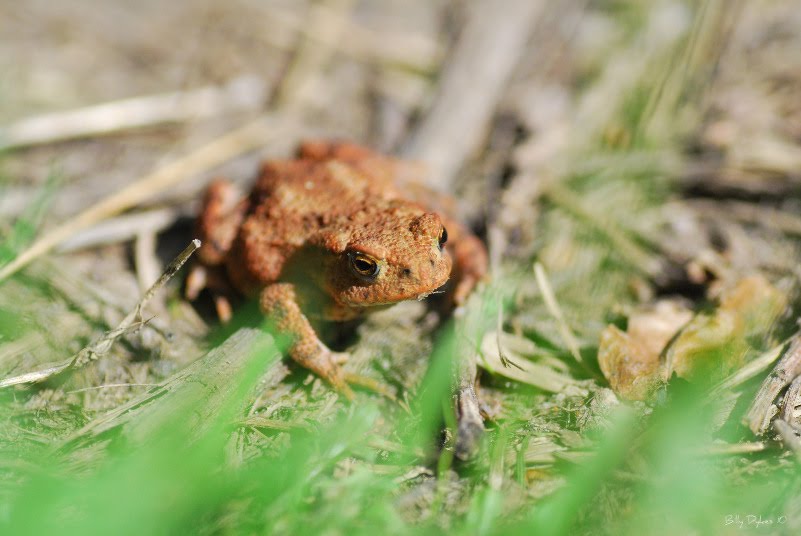
An added bonus was stumbling upon some young Toad along the path, and with help from the family, they were safely moved to an area of moist grass...


This lens couldn't be more different from what I'm used to, and the distance it can focus to is absolutely phenomenal to me at least, whilst still producing sharp and clear images.

A real test for the lens will be when I go to try and photograph a rare butterfly, occupying chalk downland in the South for just a few weeks every year, on Old Winchester Hill. See how I did in tomorrow's post...