14 August, 2015

Wildlife on the croft

When signing up to the WWOOF scheme, you generally agree to around 5 hours of work every weekday in return for accommodation and food. Being on a small organic croft on Mull meant that nature was never far away from where we worked, and with around 20 daylight hours in June there was still plenty of time to explore after we'd finished for the day. I'd dig flower beds, cut bracken, grow veg and pick strawberries whilst at the same time watching Hen Harriers display in the sky above, and pods of Bottlenose Dophins swim past on the horizon.

Hen Harrier

Dolphin watch-point

On an average day, if I wasn't drooling over displaying Hen Harriers, slobbering over calling Cuckoos or spluttering over the vast expanse of flowering bluebells that carpeted the hillsides, I could usually be found by (or in) the wildlife pond where the likes of Golden-ringed Dragonfly and Palmate Newt have made their home...

The 'wildside' of the garden

Palmate Newt

Golden-ringed Dragonfly

Yes... the croft had moths too:

Silver Hook

Hysterophora maculosana

Coleophora glaucicolella/alticolella (a tricky pair, both of which feed on Wood-rush and look identical)

Neofaculta ericetella


Green Silver-lines

Depressaria daucella 

Glyphipterix forsterella

Hedya atropunctana

08 August, 2015

This week in moths


My tendency to escape to far-away, isolated islands every summer means that I rarely get to sample the delights of summer moth-trapping in the garden back at home. It's just dawned on me that I haven't actually trapped in the garden at this time of year since 2012, so inevitably the moth trap has been on at every possible opportunity this week and there have been some interesting finds to show for it.

The highlight so far has been a Small Mottled Willow which turned up on 3rd August along with several very fresh Bordered Straws, four Diamond-back Moths and two Rush Veneers. Yet more evidence of the unprecedented migration event that has taken place this year across the country, with far more immigrants reaching this far inland than would be expected in a normal year.


Whilst there's little doubting that the Small Mottled Willow is a 'primary' immigrant, the two Bordered Straws looked like they had just emerged, and chances are they probably had. Many of the female moths which reached our shores back in May and early June, having mated across the water in southern Europe, would have been heavily laden with eggs ready to lay once they reached our shores. I've read that their offspring are noticeably darker, and that certainly looks to be the case with this one...

Bordered Straw

The resident species have also put on a good show, with Double Lobed, Mouse Moth and Pammene aurita all being added to the garden list. Jersey Tiger and a nice form of Tree-lichen Beauty added some colour to the trap, whilst numbers of the infamous Gypsy Moth and Oak Processionary - both known for their caterpillar's destructive habits towards deciduous trees - are starting to peak.

Jersey Tiger
Double Lobed
Mouse Moth
Tree-lichen Beauty
Gypsy Moth & Oak Processionary - two of the government's most wanted 'pest' species, subject to numerous eradication attempts in recent years. Despite the nasty chemicals dropped over woodlands to try and kill off establishing populations, both species are now common in south London and here to stay!

Pammene aurita

06 August, 2015

Back from the Hebrides

Almost two months later, and I'm back from the Hebrides! I arrived back last Tuesday, and have spent the majority of time between then and now quietly slagging off weather forecasters under my breath for their use of the word 'moderate' to describe wind speeds that wouldn't bother a leaf up north, and shaking my head at the continued presence of Waitrose. Basically I've come back thinking I'm a northerner.

A large part of my time in the Hebrides was spent working on an organic croft on the west coast of Mull; reached via a spectacular train journey through western Scotland, a ferry to Craignure from Oban and then an hour's bus ride through Mull - passing alongside remote upland forests, lochs, mountains and cascading waterfalls until the road came to an end at the small fishing village of Fionnphort. From there it was another 3 mile drive to Kintra, where the croft - worked and maintained for the past 40 years by the extremely resourceful and experienced married team that is Rosie & Nigel Burgess - nestles into a small remote valley, well sheltered from harsh northerly winds and providing ideal growing conditions for such a small-scale farm.


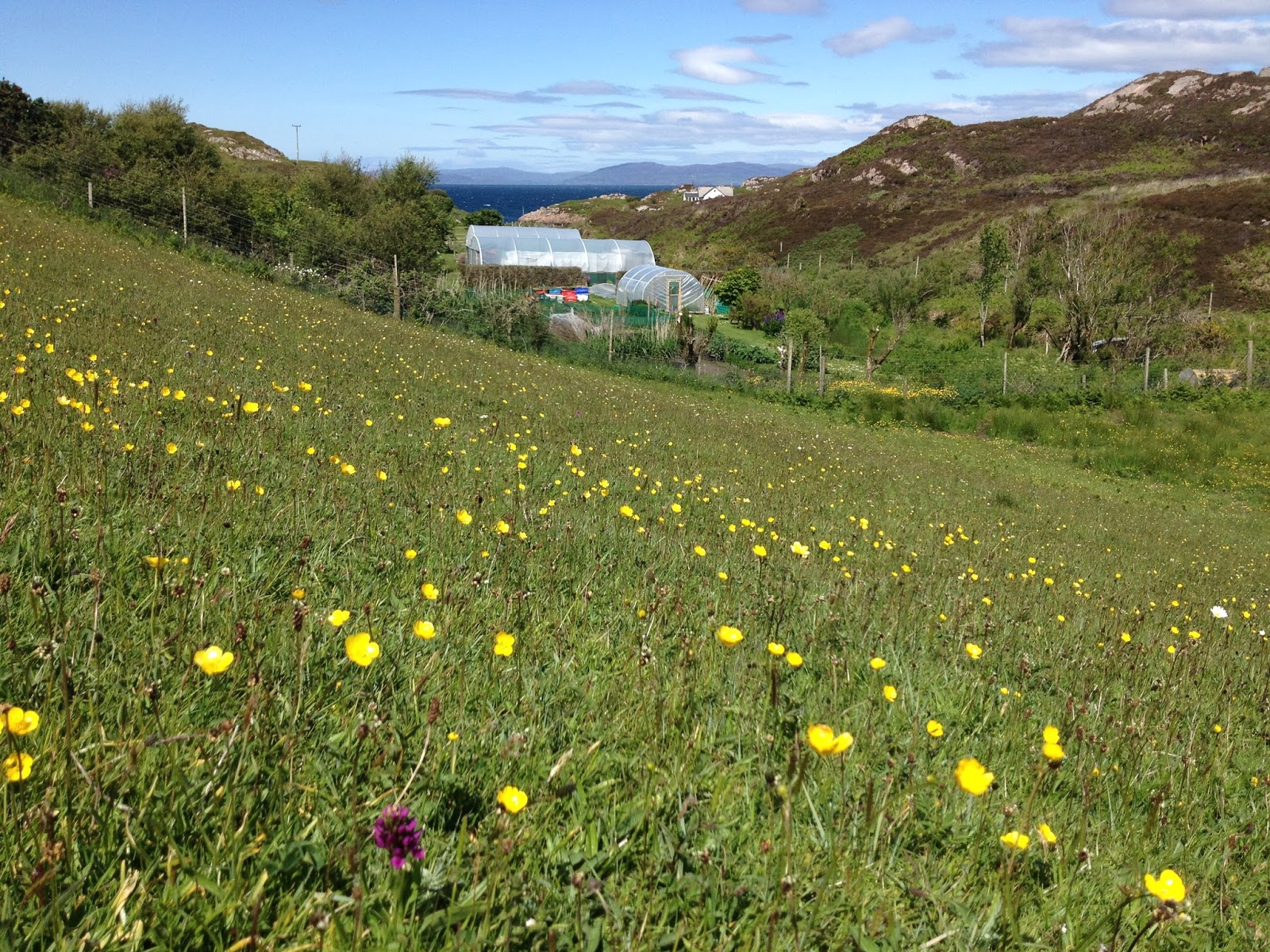
From the moment I stepped into the garden it was clear that I was going to be in heaven for the duration of the month. Four main polytunnels make up the bulk of growing space, along with various vegetable beds and fruit trees. The rest of the garden is left to grow as it pleases, with a healthy wildlife pond at one end and a small area of birch/hazel woodland nearby. Spring arrives later than in the south, and by early June  the bluebells were in full swing along with swathes of Pignut & Bird's-foot Trefoil. As well as bursting with colour, the farm was also absolutely teeming with wildlife - beetles, bees, moths, butterflies, newts, frogs & birds everywhere. The croft was like a little oasis in an otherwise windswept, heather-dominated landscape, but a truly stunning landscape at that.


Home came in the form of a small converted barn attic which I shared with three fellow WWOOFers - two sisters from Iowa who were travelling across Europe, and a guy from Reading who'd come to escape his office job. Everyone was easy-going and jolly (invaluable traits to have in remote places - you meet a lot of different personalities on islands, and bossy/grumpy people don't make great housemates!), and we all hit it off immediately - working, cooking and eating together on a daily basis, all of which was done using local ingredients. The fact that there was also a baker living on the farm was an added bonus.

Cosy!
The various landscapes I encountered whilst exploring the island - and the wildlife to be found within them - were quite overwhelming. I'll no doubt dedicate several blog posts to the natural side of Mull, but just as important for me when island hopping is meeting new people and getting 'stuck in' to their respective island communities. Mull is absolutely massive, and each village gives off a different set of vibes. Many evenings after 'work' were spent in the local pub enjoying local music and getting to know the locals (it was all tactical - the more people you know the better chance you have to getting a lift on the road).

Living in remote island communities is a way of life that seems so normal when you're doing it, but becomes surprisingly hard to explain or fully understand when you look back on it. It makes you realise just how isolated most people are in cities. Out of everyone along our street, the only people I know are the next door neighbours, and even then only on 'hello' terms. I certainly wouldn't consider walking into their unlocked house on a Friday night with a bottle of whisky, whereas in the Hebrides I wouldn't think twice!

But enough of the thoughtful, reflective crap. Moths next.

09 June, 2015

Back in a sec, just off to the Hebrides

You knew it was coming. A far-flung, people-less part of the UK is beckoning me again. This time I'm heading up the west coast of Scotland to a small croft called Kintra, nestled into the western side of  Mull where I'll spend my time practising organic farming in exchange for food and accommodation, and then in my spare time hike, swim, bird and... you guessed it, moth my way across the island. It's all come about through signing up to the fantastic WWOOF scheme, which you can find out more about here.

I've got a fair bit of land to travel over before I reach the Hebrides and my rucksack is already back-breakingly heavy, so I won't be taking my laptop with me. Unfortunate in that I won't be able to update the blog on a regular basis, although I must admit I'm really looking forward to the lack of screens after spending much of the autumn, winter and spring sat in front of the computer writing essays!

Don't despair though. I'm taking a camera with me, so if I do happen to come across a computer along the tideline, you'll be the first to know how I'm doing. If I can find this weird, magical thing they call 'Wi-Fi', then you also keep up to date with how many Orcas I'm seeing everyday through the medium of my Twitter account.

All that I guess is left is for me and this White-legged Damselfly from Norbury Park yesterday to wish you all a fantastic summer filled with biodiversity.


08 June, 2015

Odds and ends

A couple of interesting bits and bobs from the past week that haven't yet found their way into blog posts.


It's that time of year when the moth-trap is dominated by beetles. Stag Beetles are by far our most impressive garden visitors, whilst Garden Chafers are amongst the smallest.


The Clearwing lures still work - a couple of pristine male Orange-tailed (above) and Yellow-legged (below) Clearwings have been attracted to lures placed in the garden in the past couple of weeks.

Had a great time surveying biodiversity on Oxshott Heath last Saturday with the LNHS crew...

Cydia coniferana

Sundew and Sphagnum moss

Striped Ladybird

Goldon-bloomed Grey Longhorn

07 June, 2015

MVR: Migrants vs Residents

As is so often the case with urban trapping, the first week of June has seen catch rates in the garden really take off after a typically slow spring, but the big difference this year has been the appearance of migrant species amongst all the regular characters. Catching a migrant in the trap is always an exciting event, and Bordered Straws are no exception.

Before this year, I wouldn't have imagined catching even one of these powerful cosmopolitan travellers so far inland, so to have three turn up in the past 14 days alone just shows how this season's migration event is turning out to be quite monumental.

Bordered Straw

As if to cement the above statement, a Painted Lady blasted past the window as I sat down to write this post, and is now feeding on a patch of Red Valerian -  the first here since 10th September 2009!

Painted Lady

Not willing to be out done by the far-flung migrants, the residents have also been on impressive form. Buff-tip, Enarmonia formosana and Treble Brown Spot are always a pleasure to catch if only because of their shear beauty, but the real highlight of late has been this Cream Wave caught on 4th - a rare new addition to the garden list...

Cream Wave

Treble Brown Spot

Buff-tip - best animal camouflage in the UK?

Toadflax Brocade

Enarmonia formosana

Freyer's Pug

05 June, 2015

Denbies

With yesterday seeing such an impressive turn around in the weather, from 50mph winds down to almost flat calm (emphasis on almost), it seemed only right to head straight for the warm, south facing chalk slopes of Denbies Hillside - a gem of a reserve in the Surrey countryside.

It wasn't so much a trip to find wildlife as more of an opportunity to get out from the indoors and into the sun for the first time in two days, but being chalk downland in the heart of the North Downs, there was plenty of stuff to catch the eye.

Fragrant Orchid

Common Milkwort


Nemapogon wolffiella

Nemapogon cloakella

Cauchas fibulella

Teleiodes sequax - a protective 'case' created by the larva by spinning leaves together

Orchid Beetle

04 June, 2015

Argyresthia trifasciata

Plenty of these can be disturbed off our garden Cypress tree at the moment - the stunning little Argyresthia trifasciata. For someone just starting out (including myself!), the thought of identifying leaf-mines - the distinctive feeding signs left by a caterpillar on vegetation - can be a daunting task.

Indeed, there are many which are extremely similar to each other, require a hell of a lot of searching to find, or just can't be identified at all. Luckily, Argyresthia trifasciata isn't one of them and feeding signs can quite easily be found on the host Cypress by looking for discoloured brown leaves. Opening them up should reveal the feeding chamber which the larva lives in, and also its poo (resembling tiny brown sawdust) - known slightly more scientifically as 'frass'.


02 June, 2015

Weed culture

The lawn hasn't been cut in over a month, and as a result has become awash with colour from the small, unassuming wild flowers that are beginning to appear. Having spent the past couple of months fascinating over the plants that have colonised the alley way adjacent to our student house (here and here), it's been uplifting to witness the pulling power that they have on pollinating invertebrates - a power that is completely destroyed the minute a strimmer goes over them.

In recent years, wildlife has taken a front seat in the conscience of the average middle-class gardener, not least due to greater publicity surrounding the declines of many of our iconic species. Wildflowers which were previously considered to be intrusive garden pests are now seen as important sources of nectar for bees, and more of us than ever are setting aside untamed areas where grass is allowed to grow tall - we're learning to live with nature in urbania.

They're not weeds, they're wildflowers.

Procumbent Yellow-sorrel

Thyme-leaved Speedwell

Lesser Trefoil

Common Mouse-ear

Dove's-foot Cranesbill

Unfortunately, it's a mindset that hasn't quite reached the local council yet - below is the view from the main entrance to Stokes Field the other day. The flattened grass on either side of the dirt path would have been a vibrant mix of Cow Parsley, Wood Avens and Herb Robert a couple of weeks ago. 

Path widening my ass.