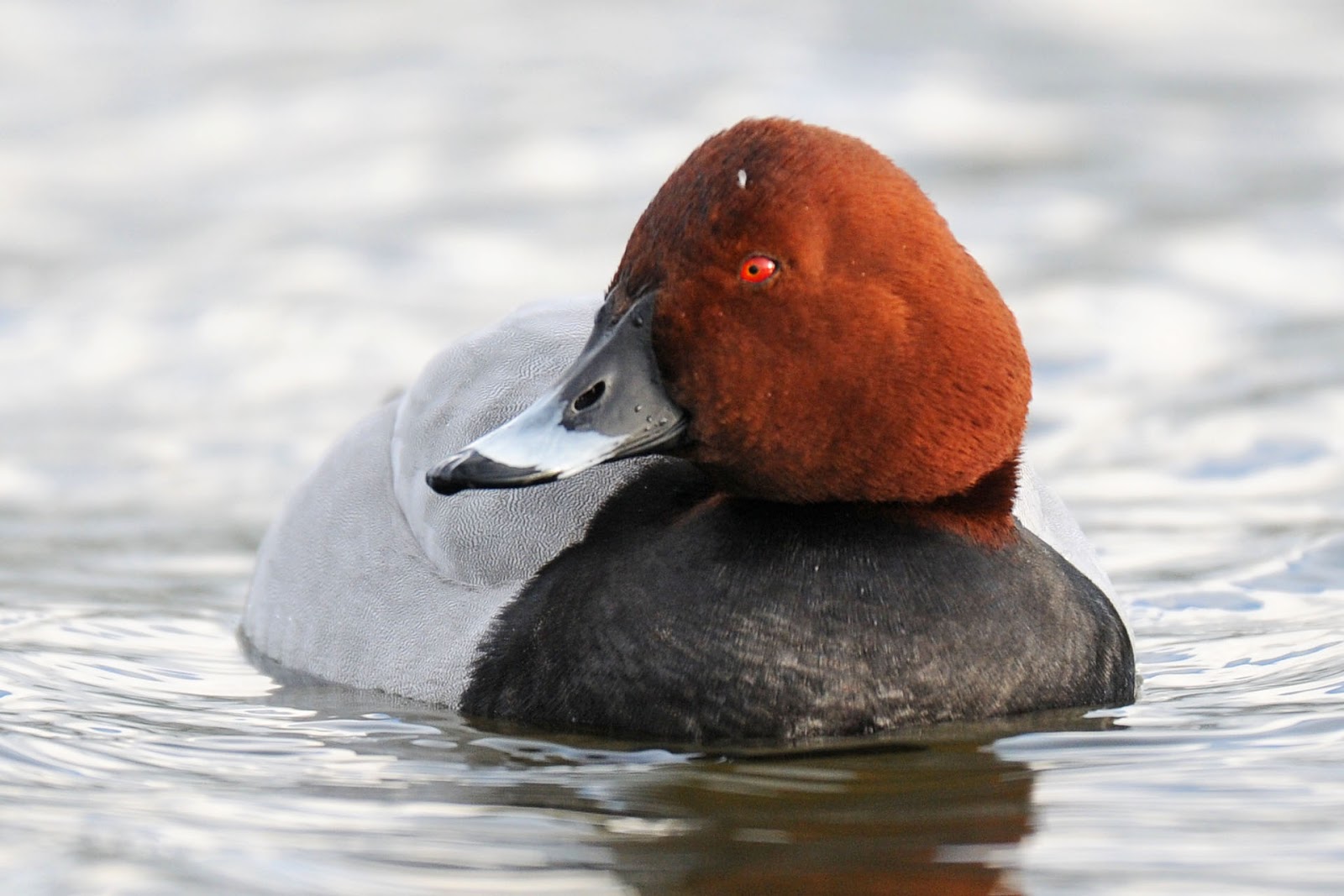
10 February, 2013

Changing the subject slightly...

... with some Pochards in Bushy Park.


Always been one of my favourite ducks- they just seem so chilled out all the time- I've ever seen a Pochard swim anywhere in a hurry...one minute they're feeding, next minute they've fallen asleep.

09 February, 2013

On the subject of gulls...

... here's a few Black-headed Gulls that I went all artistic and stuff on in Bushy Park on Tuesday, with a rare bit of afternoon sun providing some nice backlighting on a shaded pond in the woodland gardens.


... I need to stop being so amazingly creative.

08 February, 2013

That Gull Again


What's that? You want more images of that Bonaparte's Gull in Eastbourne? Fine, if I have to.


06 February, 2013

How to over-photograph a Bonaparte's Gull

Found myself taking a 75 mile detour to the local patch this morning via Princes Park, Eastbourne, to twich a winter plumaged adult Bonaparte's Gull on a small boating lake by the seafront. I haven't been to the seafront in donkey's years, so I'll use that fact as the main excuse for taking an hour and a half train journey to twitch a seagull (sounds pretty bad when you put it like that)... plus the fact that its a very smart looking bird, showing ridiculously well at times to the steady flow of photographers who have visited in the past week.

Unlike other gulls, Bonaparte's Gull is unique in that it build its nests in trees, mainly in the taiga forests of Alaska, with a few birds making landfall in Britain in most years. This particular bird seemed quite at home on the boating lake, generally avoiding the large congregation of Herring Gull and Black-headed Gull, but joining the feeding frenzy whenever a slice of bread was whipped out.

Note the all black bill, more 'compact' size, and pinkish legs, which helped distinguish it from the 100 odd Black-headed Gulls also present without too much hassle...


Two hours and 500 shots later, it was finally time to end an intense seagull photography session, and I headed back towards the station, passing a very confused Black-headed Gull in full summer plumage, and a single Turnstone scavenging along the concrete banks of the lake.


After a surprisingly easy journey home through Sussex and London during rush hour, I made it home with just enough light left to pick out a flowering Snowdrop in the front garden, bringing my 1000 species in a 1km square total to a pathetic total of 87... and there I was just last week promising myself that I would stay local this year!

05 February, 2013

Lesser Spotted Woodpecker, Bushy Park


As is now commonplace across many of its former haunts in Britain, Lesser Spotted Woodpecker has become somewhat of a rarity in Bushy Park, with numbers dropping year on year to probably only a single breeding pair at present. Last year in the Park, a pair became active from mid-February onwards in the Canal Plantations, and so it was a relief last night to read that yesterday, Royal Parks birding ace Tony Duckett had come across the first bird of 2013, in the same stretch of oak trees as last year's woodpeckers. Ridiculous plans to twitch a seagull in Eastbourne were duly scrapped, and I headed down to the patch late this morning for this increasingly rare sight in the Park.

A few Parakeets and Treecreepers later, I found myself on the south side of the Canal Plantation enclosure, where the female was showing brilliantly, actively feeding and drumming in front of the four of us who had braved the cold wind to enjoy this bitesize pecker. No sign of a male yet, but its still early days- I'm looking forward to keeping up with their progress throughout the next few months.


04 February, 2013

Blue tit appreciation

I recently treated myself to a cheap(ish) photography hide off Amazon, and managed to get great use out of it during the snow fall in January. It's only a small little thing- seating one person- and is easily set up within seconds, without the need for any pegs, poles or crap like that.
 
This makes it ideal for quick 20 minute morning sessions in the garden, so after baiting a bamboo cane with a rotting apple, I did just that. Unfortunately, the three Blackcap that have been partial to apples in the garden recently didn't show, but this curious Blue tit more than made up for it, and found the bait with ease. Gotta love Blue tits.


31 January, 2013

1000 species, 1 square

What with it being a new year and all, I thought I'd set myself a new challenge- to find and record 1000 species in a single 1km square. Unfortunately, I can't take credit for sprouting the idea behind this brilliant task- that hat goes to a man called Andy Musgrove, who thought it would be a great idea to completely bio-blitz his home 1km square just outside Norwich, by setting himself a target of 1000 wild species by the end of 2013.

Since putting the idea online, he's gained a number of followers willing to add their square to the challenge, and thus an element of competition has brewed to see who can reach the big four digits first, and possibly go beyond. You can find the challenge at http://1000for1ksq.blogspot.co.uk/

With a lot of committment, and a few late nights spent identifying those obsure green fungi, I'd like to think its a do-able task, even in suburban Surrey, and after spending a good hour staring at the OS map trying to work out how to get the best out of the (limited) habitat in the local area, I've measured up my very own 1km square in Thames Ditton, from which I hope to make a decent attempt at recording 1000 species.


Hopefully, most of the magic is going to happen where that blue bird is sitting in the middle of the square, on my local urban fringe site, Stokes Field. It's a small mix of woodland and grassland, along with an exposed hilltop, and abandoned rose field at the south of the site, which should be good for invertebrates (just before the A309- which I'll be using as the southern most boundary to the km square). The blue arrow to the west indicates the most important habitat in the square, the garden. At the end of the day, it's the easiest place to get to, and it also happens to be where I run a moth trap pretty much every night through the summer, so it would seem mad to leave it out.

The likelihood that I'll actually reach 1000 species is pretty low, as is the likelihood that I'll remember to keep this going throughout the year (or at least until October when I head off to Uni), but if it gives me a bit more motivation to stick to the patch, and the chance to improve identification skills on insects that I wouldn't normally bat an eye lid at, then its worth a try. I'll still be able to stay dedicated to other local patches (Bushy Park etc), but this'll be a interesting little thing to do on the side.

Let the fun begin...

28 January, 2013

Adapting to the Cold


The Fieldfare that hung around in the garden during the recent snowfall appears to finally have parted ways, allowing other birds, such as this female Blackcap, to get their share of the apples...

 
In recent winters, both male and female Blackcap have turned up in the garden on odd occasions, mainly during very cold weather. Blackcaps are one of the few warblers- along with the Chiffchaff- to be able to hold a sustainable wintering population in Britain, partly owing to their ability to widen their diet during hard times- when insects may not be so easy to find. Whilst the apples have provided the main attraction in the past few weeks, this female Blackcap has also become a pro at cracking open sunflower seeds from the seed feeder, and even hanging acrobatically from the fatballs!

26 January, 2013

Pallas's Warbler

I don't know what came over me to even consider doing it, but this morning I found myself boarding an hour long train to Berkshire, just as any normal person would do at half 9 on a Saturday. I've always considered myself a patch birder at heart- there's few places I'd rather spend my time birding than out on my local patch, Bushy Park- with the odd trip here and there around Surrey if something nice turns up- but only once have I ever been out of the county to twitch something, and that for a Sparrow, many moons ago.
 
The main motive behind this random inter-county trip to Berkshire was the promise (or rather, hope) of an absolutely stunning Pallas's Warbler spending the winter along a small stretch of the river at Moor Green Lakes, near Sandhurst. The warbler in question, a scarce wintering bird from Siberia, has been seen on and off at the Lakes for almost a month, and since I've had a little bit of a thing for small, bright green warblers ever since the experience of wading through Yellow-browed Warblers on Scilly back in October, it seemed only right to pay it a visit.
 

It's small size and its tendancy to associate with extremely active tit flocks in vegetation on the other side of the river, made the Pallas's very hard to pin down; never staying in one spot for more than a few seconds. Still, on the one occasion it did come out into the open during my visit, it showed just why its been drawing in the crowds. Look at that eye-stripe.. what a beauty!


 P.S. You may have noted that the blog has undergone a radical make-over for 2013. Testing out a few new looks for it at the moment, so do let me know if you think it absolute rubbish... I'll try and hold back the tears.