27 August, 2010

Good Weather For Ducks

Good Weather For Ducks...

Actually, I wouldn't be surprised if even the ducks are getting a bit pee-ed off at all this rain that is falling out of that grey mass of crap above our heads-- although some may like to call them clouds.

However, due to the undeniable fact that I've neglected all local patches that I ever had, I had to get down to Bushy Park. Luckily, there was a weather window; the sun was shining, and birds were singing... only kidding, it was raining and it seemed that, as we got out of the car, the weather deliberately decided to get worse, from typical English summer, to the kind of weather I would expect on Shetland in an extremely bad winter. However, knowing that the ducks were craving to have their photos taken of them, I pushed on.

There were no ducks on the main lake, unless you can call a branch looking like a duck a duck, which technically you can't. However, all wasn't lost. I found a duck! An eclipsed male Red-crested Pochard,  on the next lake further up from the main lake, looking pretty annoyed at himself for not booking that holiday to the Caribbean a little earlier...


I'd post a photo of the branch to brighten up the post but I'm not very confident on the identification (it's been so long since I last saw a British duck I'm starting to forget what they look like). It could be a Red-billed Whistling Duck, or a Baikal Teal... probably blown in with all this weather.

To lighten up the subject, I look outside as I write this to a smidgen of blue sky. Who knows, prehaps that tiny seed will grow into a mighty oak, prehaps the sky will change colour overnight, and we will wake up to a new world... I doubt it. I think we've all learn't a lesson today- never go out in the rain because you won't see any ducks, so don't even bother trying.

25 August, 2010

Menorca- The New Birding Approach

Menorca- The New Birding Approach

Sorry for the lack of posting recently, I know how much you have haven't been missing my fabulously  poorly stringed-together posts, amazing rubbish pictures and frequent occasional updates.
Anyway, I'm back, and more good news is that I found my preferred method of wildlife watching whilst in Menorca over the last 2 weeks. It included a deck-chair, cold drink, hot sun and preferrably a pool or beach as the habitat.

Our villa was situated on the south coast of the island, and like most of Menorca, the area extremely rich in wildlife, mainly due to the government rejecting many plans to build large tourist resorts and other attractions that could leave Menorca heading for the same fate as Ibiza (no offence Ibiza, and not that I don't like that kind of lifestyle).

With wildlife came photographic subjects, and one of the first birds to hit the camera lens was a Turtle Dove; a species I have yet to encounter in Britain, and with its current rate of decline, my chances of seeing it are getting slimmer. No such problem in Menorca however, where their weird and bloody annoying two note call would wake me up every morning!


Another commoner in and around the garden was the Spotted Flycatcher, and every evening a family of six would congregate on the telephone wires outside the villa and flit around in the evening light. The problem was that they would usually appear just after the sun had gone down for a 10 minute period, and the light was not brilliant for a frame filling 300mm shot.

However, this shot was an exception, and I managed to catch the bird in good enough light to make it showable...


Whilst waiting for the Spotted Flycatchers to show up, my vantage point gave a good view of the sunset...


What we didn't realise when looking at the villa on the internet, was that they had a resident family of Hermann's Tortoise living in their garden. The tortoises had a mind of their own, and were constantly on the move, feeding off salad and roaming around the house like it was theirs. This family included at least two very young tortoises. To give you an idea of size, the baby on the left is not much bigger than the palm of your hand... dinky or what?


Talking about reptiles, as you'd expect on a hot Mediterranean island, lizards were abundant, but very hard to get close enough to identify, let alone photograph. Probably the most common lizard in the area was the Italian Rock Lizard, originally imported into the Balearic islands from surrounding Europe, being resident in Italy (would never have guessed!) and much of mainland Europe.

Occasionally, I would take a lizard by surprise whilst it was sunning itself in the glorious weather and it would give me a few seconds to take a shot (try and ignore the whappin' great green grass stem going slap bang through the middle of the shot. Typical)...


But it wasn't all about common species... oh no. Whilst scanning a wader scrape at Es Grau nature reserve, one of the largest of it's kind in Europe, watching Black-winged Stilts and a Marsh Sandpipers, I got onto a large, stocky Moorhen type bird with a stocky bill. There was no mistaking it... a Purple Swamphen!

A very local and rare breeding bird in Europe, where it is only found in marshy areas of the Balearics. Score!

Yeap, yeah... that tiny blob in the middle of your screen wading through that swamp is a Purple Swamphen, honest! And it is purple, not that you can tell from this awful photo...


A slightly more scenic view of Es Grau NR...


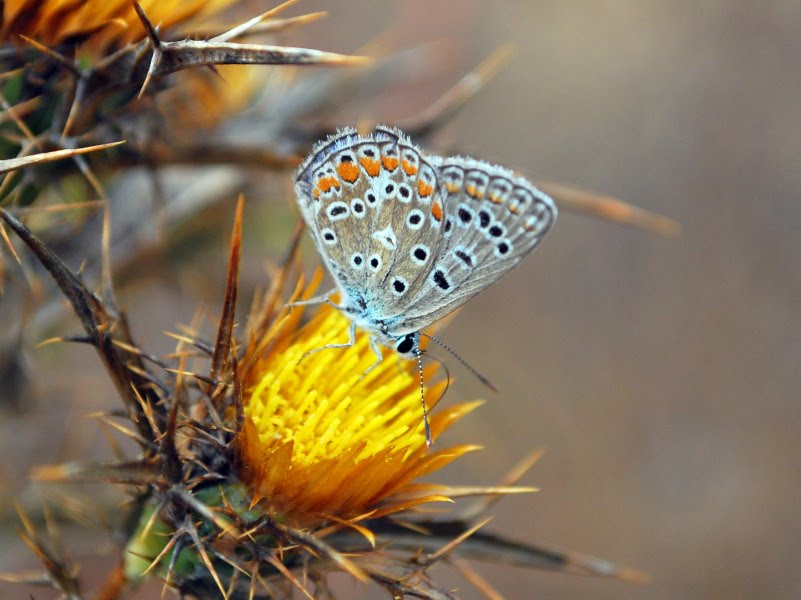
There were plenty of insects to photograph at Es Grau. Most of the butterfly species I couldn't identify, as I had no knowledge whatsoever of Mediterranean insects, and I even needed help identifying the following Common Blue and Speckled Wood (both common in Britain)...

Common Blue...


Speckled Wood...


Just about the only damselfly I could identify, a Blue-tailed Damselfly. Relatively common here in Britain but one I've yet to see at home...


As the days went on, I found the amount of time I spent with the camera was decreasing almost as dramatically as the little Turtle Dove from Britain, and the amount of time I was spending on the beach was increasing. Before I knew it, the 2 weeks were up and I came away with a surprisingly empty SD card.

Sadly, many species missed the camera; Orphean, Sardinian and Cetti's Warbler, Egyptian Vulture, Black Kite, Hoopoe and Bee-eater are just some of the beasts that managed to vanish the second I pointed my lens in their face.

Ah well. All in all a very nice holiday, and you have to agree with me that chill-axing on a sandy beach with a cold drink, watching the odd Audouin's Gull fly by (along with plenty of birds... wink wink), is probably the best possible way to birdwatch... ever ;-)

23 July, 2010

Silver-washed Fritillary

Silver-washed Fritillary

The largest Fritillary in Britain, and one which I have never seen before; I was kindly given directions by Frank (The Early Birder) to Bookham Common just a few miles down the road, where the Silver-washed Fritillary will be reaching its peak.

With the weather window we needed, my mum kindly offered to take me to the Common on Monday, and we were greeted by 100s of these striking orange and black streaked butterflies.

They spent most of their time feeding on thistle in the sunny clearings, but were easily disturbed and without a proper macro lens, I used the telescopic; having the advantage of not needing to go too close to get a shot.

The sun was extremely bright, which produced many 'fried' images, but also a few ones that I don't think are too bad.


A side on view...


These guys will be on the wing throughout August so I might give it another shot at them... literally.

18 July, 2010

Good Old Winchester Hill

Good Old Winchester Hill

Old Winchester has got to be one of my favourite nature reserves in Britain, because of it's brilliant views and also stunning range of wildlife that can be found there. It is arguably the best sight in Britain to watch butterflies, solely because of the range of specialist wildflower that grow on the chalk downland slopes, providing excellent feeding for specialist butterflies.

The butterfly I was looking for when I went down there the other day was Chalkhill Blue, and as the name suggests, its favoured habitat is chalk hillside.

The weather wasn't brilliant as we left, with grey clouds and rain overhead. Hopefully though, the bad weather would break up as we reached the south downs (area of hills)... obviously, it didn't, and we arrived to find many of the butterflies sheltering on grass stems, especially the smaller, weaker flying species like Small Skipper...


Some of the stronger fliers, such as the stunning Marbled White, braved the windy weather, and happily fed and perched out in the open...


As mentioned earlier, the reason butterflies flourish here is because of the specialist wildflowers that grow on the chalk slopes, including Common Agrimony, the footplant of Grizzled Skipper, abundant on the hillside in late spring...


The yellow flowers below are Lady's Bedstraw...


... Apparently, they can be used to cure the smell of stinking feet; I'm starting to regret not pickin- errm... anyway, here's a nice Ringlet that was resting on the path...


Up on the Celtic hill fort, it was evident that Yellowhammers were breeding, with adults carrying caterpillars into the surrounding shrubland...


Back to the task in hand, and slowly but surely the weather began to improve, with the odd bit of sunshine coming through. By this time though, we were reaching the end of the walk with no Chalkhill Blue to boot. Suddenly, a glance over the left revealed a blue butterfly... but was it a Chalkhill?

It finally came down to land on a bramble and bingo, those chequered patterns to the wings identify Chalkhill from all other British Blues...


It performed for another 10 minutes but was far out in the brambles, and I had shorts on, so common sense told me not to go prancing into the brambles!

... Success, I think so!

13 July, 2010

Small Copper

Small Copper

I seem to have abandoned Bushy Park recently, even though it provides great opportunities for photography and is only a short cycle from the house. Butterflies seem to be everywhere at the moment and with only one photo of Small Copper in the archive, a colourful but common species, I headed down to Bushy Park where the butterflies would be reaching their peak.

The park is made up mainly of grassland and ferns, and it's clearings like this that are ideal for butterflies, with wildflowers such as daisies making easy pickings for them...


In this particular clearing, Small Skippers were also abundant, and it didn't take long for me to find a Small Copper as it patrolled its territory. They are very territorial and this male would intercept any insect, including Small Skipper incase it was a passing male, or even better, a female.

They are very active little butterflies, and I could only get close enough for a photograph when the male sat on a vantage point (i.e. fern, grass stem) across his territory...


Or in this case, a leaf...


Meadow Pipit...


After a while, the sun's heat became a bit too much and I decided to call it a day, a bit unsatisfied with the result.

11 July, 2010

Doesn't Get Much Better Than That

Doesn't Get Much Better Than That...

Remember that time when luck was just on your side... everything was going right... nothing was going wrong? No, neither do I; but I got pretty damn close last week, during a few nights stay at the grandparents house in Suffolk.

Being the absolute donker I am, I managed to leave my camera kit at home. In a nutshell...

"Right, time to do some photography. Hmm... I wonder where my camera is? I'm sure I packe- damn!"

This mean't that for the first three days I couldn't take any photographs at all; none at all; zilch; nil; zero, and I was literally crying myself to sleep at night. Anyway, on the fourth day I had my baby back safe with me via a pretty useless courier.

Before the trip, we'd been given a tip off as to where we could see Nightjar, one of those birds that most birders dream about, at Blaxhall Common by the coast. It was a healthy distance from where I was staying, so to make it a day trip we set out to RSPB Minsmere, and with camera in hand, I was hoping for some photos.

By the entrance feeders, this female Chaffinch was having a bit of a shocker with her plumage. I mean that style is sooo last year...


The reserve is dominated by reedbed, and Sedge and Reed Warbler were in full song. Occasionally the odd Sedge Warbler would pop up, albeit distant...


Down along the beach, I failed to pinpoint any Little Terns, but we did get distant and brief glances of a Grey Seal out in the sea. Believe me, it is a seal...


Back down on the wader scrape, much of the water was dried up, but a small pool had been adopted by a family of Avocets...


The juveniles, note the hint of a greyish brown tinge to the plumage...


Despite the young birds large size, the adults were still very protective, and were constantly chasing away nearby Black-headed Gulls...

The gull then decided to take his revenge. Getting ready to give the Avocet a good old slap...


With the sun low in the sky, we decided to head off to our next and last location of the day, Blaxhall Common, in the hope of finding Nightjar. The conditions couldn't have been better with a warm temperature and no wind. The sunset...


A clearing in a woodland were the Nightjars were located...


As the sun went down, I was amazed to hear a Dartford Warbler singing and briefly showing in the gloom, but it was too dark to get a shot.

Then, right on queue at 9.30pm, we heard a churring noise in the distance... Nightjar! Another churring noise started in a tree to the left and it soon became apparent that there were at least two males calling. From then on until 11pm, the Nightjars churred non-stop and flew right over our heads on several occasions. It was too dark for an acceptable photo but we did record a video with churring in...


At 11pm, the noise started to die down and eventually stop, although it was starting to freak me out.

On the final day, we took a brief trip to Lackford Lakes SWT before I took the train back to London.

With the amount of luck we'd already had with the Nightjars and the seal, we decided to try our luck in the Reed Hide, famous for Kingfisher sightings. After a painstaking and ass-breaking 5 minutes of sitting still in the hide, a little blue bird came and sat in full view on the wooden post designated especially for it...


So there you go, two of my personal best wildlife experiences in two days. I think it's safe to say that it doesn't get much better than that. I'll leave you with a little ickle bunny wabbit, just chilling out. I definitly feel like a sit down after this post.


01 July, 2010

The Winning Streak Continues

The Winning Streak Continues...

Actually, that title is pretty debatable. The winning streak actually started and finished about a week ago, but Mr BT Home Hub and the laptop haven't been getting on recently and so Mr Home Hub decided to muck up laptop's internet connection, stopping me from posting this earlier in the week when it actually happened... if you follow my strings. Luckily though, I got them to apologise to each other and the internet is now back to normal.

Anyway, the winning streak refers to Hawk-moths, and only the night after catching the Elephant Hawk-moth, I caught the garden's second species of Hawk-moth, the Lime Hawk-moth.

Not quite as pretty, but still a very smart looking guy...


Enjoy. I'll try not to bore you with moths too often, except when I get a really good one, I'll save most things moth related for this blog... worth a peek if you like what you see here.

25 June, 2010

Ever Caught A Pink Elephant?

Ever Caught A Pink Elephant?

... I have, it was in the moth trap last night. No, it wasn't a real elephant, that would be a bit weird, and it wasn't a drug either... it was a brilliant Elephant Hawk-moth and I'm still physically shaking from the experience.

It all started when I came back from a gig and decide to put out the trap for a while. I wasn't expecting much as it was late. After 20 minutes, I heard 'the thud' that as any moth trapper will tell you, means that you need to run-to-the-trap-as-quickly-as-possible-because-you-have-something-big-on-your-hands.
With small container at the ready, the ones you put pee samples in (don't ask how I got them), I ran to the trap... and there it was.

You don't need to know my first thoughts because they included some bad words, but my second though was "I'm gonna need a bigger container", so I rushed back into the kitchen, came out with a large sandwich box and potted the moth, knowing I wouldn't get any sleep thinking about photographing the thing in the morning.

Morning came and I woke up at the bloody early time of 11am, instead of late afternoon... the things I'd do for a flippin' moth! I stuck it on a leaf and here is the finished result...

That is one stupidly beautiful moth.


Look at that thorax. Get a load of that trailing edge to the hindwing. Don't even get me started on the leading edge and that mouth watering basal cross-line. Kill me now please...


And if you thought that was all, think again. I also caught a Leopard Moth, another exotic looking moth that I'd ask out any day... if I was a moth...


And if your not already on the phone buying a heavy duty moth trap, then this should make you. A Blotched Emerald in all its blotched beauty. One of two which I also caught last night...


I'd just like to say that this is actually what these moths look like, so colour enhancing or stuff like that. Now if these moths don't rock your boat, flip your haystack or ruffle your feathers, then I don't know what will!